
Kettlebell Home Workout
No access to a gym but you call a kettlebell your own? We have carefully composed this full body workout for you with the most effective exercises which require just one kettlebell. No excuse, get started today!
Extreme Kettlebell Home Workout
7 exercises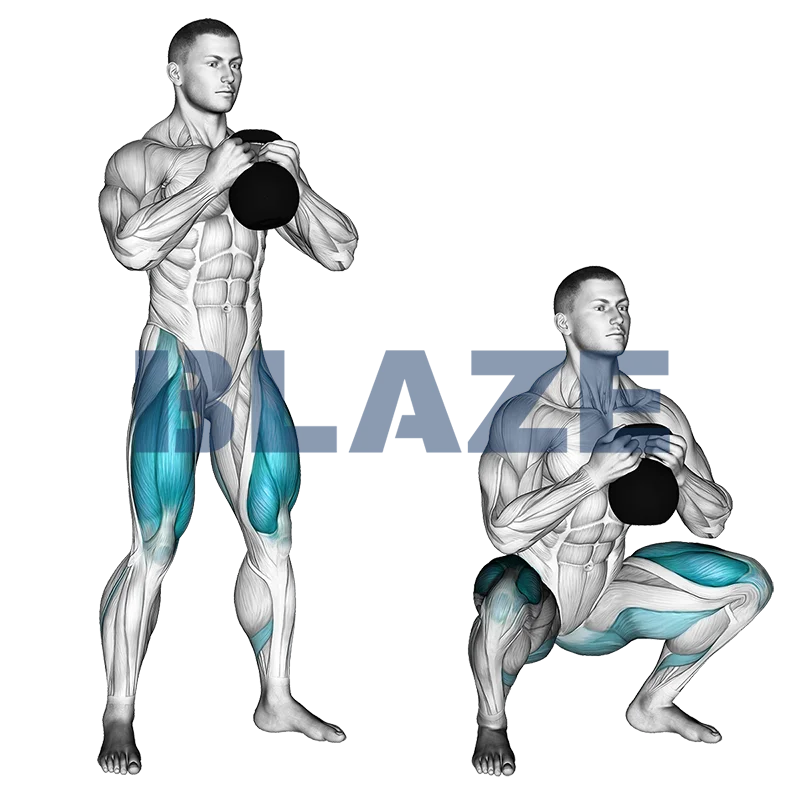
The goblet squat is a versatile exercise offering numerous benefits, including enhanced core stability, improved lower body strength, and better posture. This exercise primarily targets the quadriceps, glutes, and hamstrings, while also engaging the core and upper back muscles. Athletes can profit significantly from goblet squats as they improve functional movement patterns, enhance athletic performance, and reduce the risk of injury. The exercise's ability to build strength and endurance in key muscle groups makes it an excellent addition to any training regimen.
Community Averages
16kg
Avg. weight
36lbs
Avg. weight
* Based on data from the Blaze community
Description
- 1Starting Position: Stand with your feet shoulder-width apart, holding a light kettlebell by the horns close to your chest.
- 2Squat Down: Lower your body into a squat by bending your knees and hips. Your hamstrings should touch your calves. Keep your chest and head up, and your back straight.
- 3Knee Push: At the bottom of the squat, pause and use your elbows to gently push your knees outwards.
- 4Return Up: Straighten your legs to return to the starting position.
- 5Repeat for the desired number of reps.
Tips & Tricks
- •Maintain an Upright Torso: Keep your chest up and your back straight. Imagine you are trying to keep your sternum pointing forward throughout the movement.
- •Proper Foot Positioning: Place your feet shoulder-width apart or slightly wider, ensuring your toes are pointing slightly outward. This will help maintain balance and engage the right muscle groups.
- •Grip the Kettlebell Correctly: Hold the kettlebell close to your chest with both hands, ensuring it's secure. This helps to keep the weight controlled and centered.
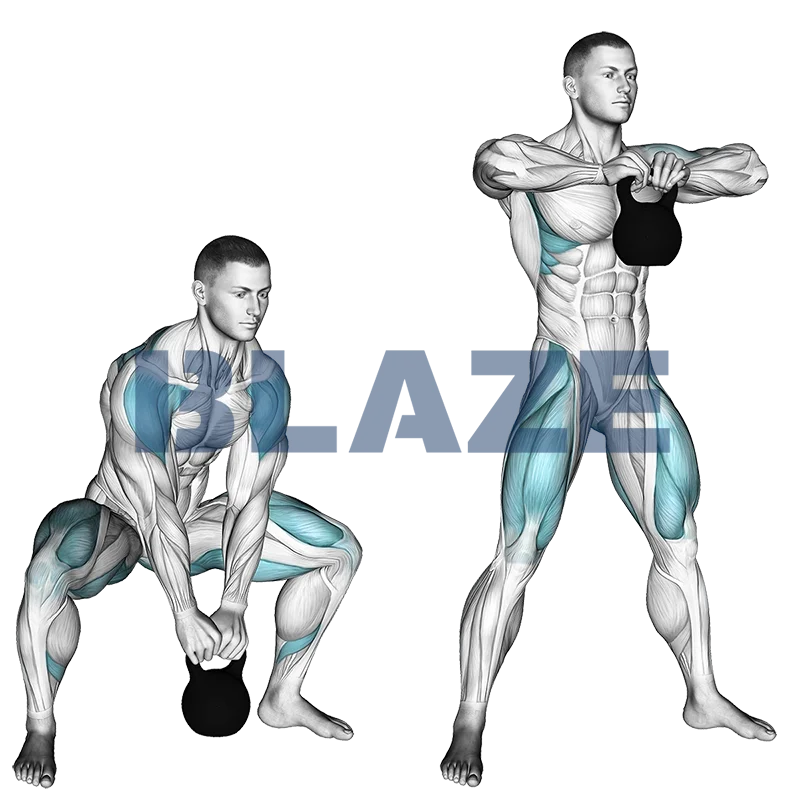
The kettlebell sumo high pull is a total-body exercise offering numerous benefits. It primarily activates the quads, hamstrings, glutes, shoulders, and traps, promoting strength and power. Athletes profit from this exercise due to its ability to enhance hip drive and explosive pulling strength, crucial for sports requiring rapid, dynamic movements. The sumo stance also improves hip mobility and stability, essential for performance and injury prevention. Additionally, it aids in conditioning and cardiovascular fitness, making it a well-rounded addition to any training regimen.
Community Averages
19kg
Avg. weight
42lbs
Avg. weight
* Based on data from the Blaze community
Description
- 1Stand with your feet shoulder-width apart and position a kettlebell between your feet.
- 2With arms straight and maintaining a neutral back, hinge at the hips and slightly bend your knees to grasp the kettlebell handle with both hands.
- 3Exhale as you squeeze your glutes, straighten your hips, and lift the kettlebell by standing up, keeping your arms straight and back neutral.
- 4Inhale as you hinge at the hips again, push your glutes backward, and slightly bend your knees to lower the kettlebell back to the ground.
- 5Repeat this motion for the desired number of repetitions.
Tips & Tricks
- •Maintain Neutral Spine: Keep your back straight and your chest up throughout the movement. Avoid rounding your back to prevent injury.
- •Engage Your Core: Tighten your abdominal muscles to stabilize your torso and protect your lower back. this will help in maintaining proper form during the entire exercise.
- •Use Your Legs and Hips: Initiate the movement by pressing through your heels and engaging your glutes. The power should come from your legs and hips rather than your back.
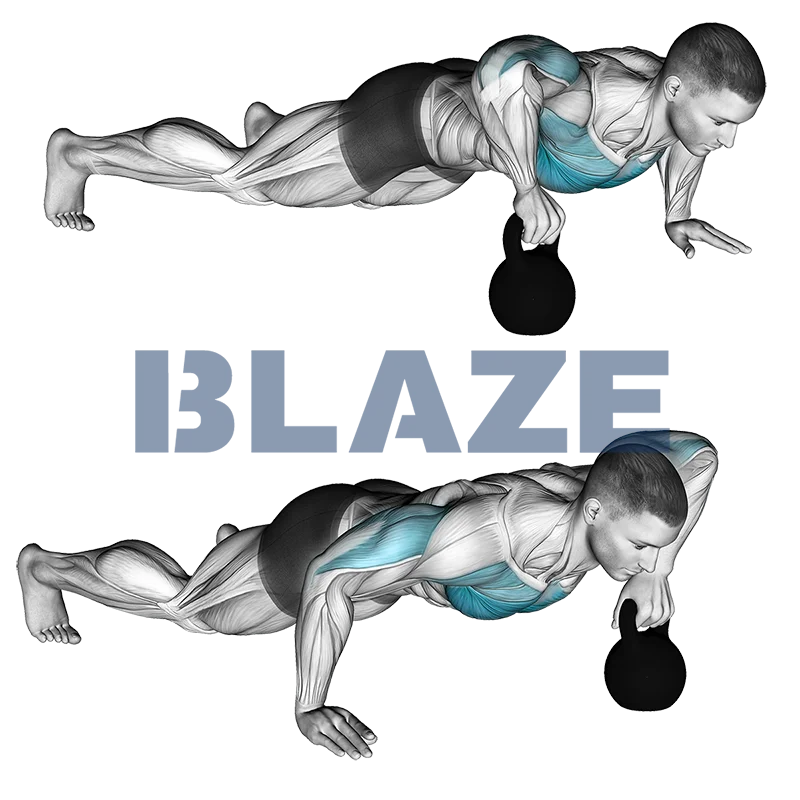
The kettlebell plyo push up is a robust exercise enhancing explosive power and stability. It primarily activates the pectorals, triceps, and deltoids, with a significant engagement of the core and stabilizing muscles. Athletes benefit from improved upper body strength, agility, and coordination due to the high-intensity plyometric action. The exercise's dynamic nature boosts cardiovascular fitness and helps in developing faster reaction times and greater muscular endurance essential for various sports performance.
Community Averages
26kg
Avg. weight
57lbs
Avg. weight
* Based on data from the Blaze community
Description
- 1Begin in a quadruped position on the floor with your hands gripping kettlebells. Your toes should be tucked under, and your knees should be positioned directly under your hips.
- 2Extend one leg at a time to assume an extra-wide stance. Keep your elbows straight and your head in a neutral position, looking at the floor.
- 3Slowly lower your body by retracting your shoulder blades and unlocking your elbows.
- 4Continue descending until your upper arms are parallel to the floor or your chest is slightly below the kettlebells.
- 5Push yourself back up to the starting point by extending your elbows and driving your palms into the kettlebells.
- 6Repeat the motion for the desired number of repetitions, ensuring you maintain proper form throughout.
Tips & Tricks
- •Start Low: Begin with a lower height kettlebell. This reduces the intensity and helps you master the movement before progressing to a higher kettlebell.
- •Wrist Positioning: Ensure your wrists are directly over the kettlebell handle. This alignment helps in reducing strain on your wrists and improves stability.
- •Core Engagement: Keep your core engaged throughout the movement. This not only maintains proper form but also protects your lower back and prevents sagging.
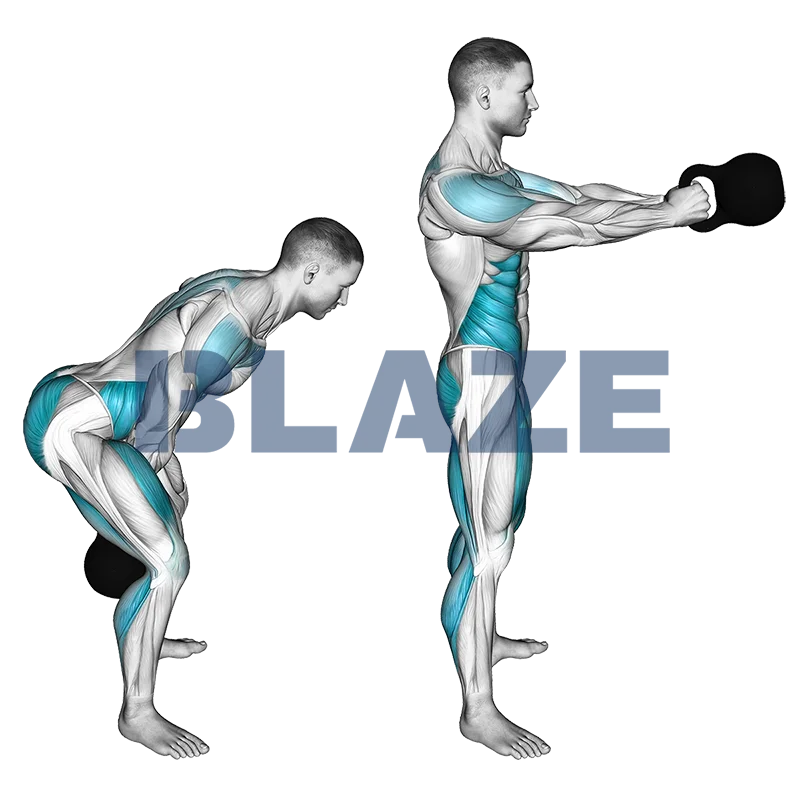
The kettlebell swing is a dynamic exercise offering extensive benefits, prominently enhancing cardiovascular fitness and muscular strength. It targets multiple muscle groups, primarily the glutes, hamstrings, and core, while also engaging the quads, shoulders, and back. Athletes profit from improved hip power, endurance, and posture, translating to better performance in sports and reduced injury risks. This exercise boosts explosive strength and metabolic rate, making it an essential addition to any fitness or athletic training regimen.
Community Averages
16kg
Avg. weight
36lbs
Avg. weight
* Based on data from the Blaze community
Description
- 1Stand with your legs a little wider than shoulder width apart, with the kettlebell between your feet.
- 2Hinge at the hips and a little at the knees, grasp the kettlebell with both hands, and lift it a little off the floor by extending your hips.
- 3Inhale as you slowly swing the kettlebell backward and up between your legs.
- 4Forcefully extend your hips and knees to swing the kettlebell up in front of you. Squeeze your glutes at the top.
- 5Hinge at the hips and a little at the knees as the kettlebell swings back down. Guide the kettlebell between your legs.
- 6Repeat the swings for the prescribed number of times.
Tips & Tricks
- •Hip Hinge, Not Squat: Focus on hinging at the hips rather than squatting. Your knees should bend slightly, but the power should come from your hip drive.
- •Neutral Spine: Keep your back straight and avoid rounding it. A neutral spine protects your lower back and helps drive power from your hips.
- •Engage Your Core: Tighten your core throughout the motion to protect your spine and provide stability.
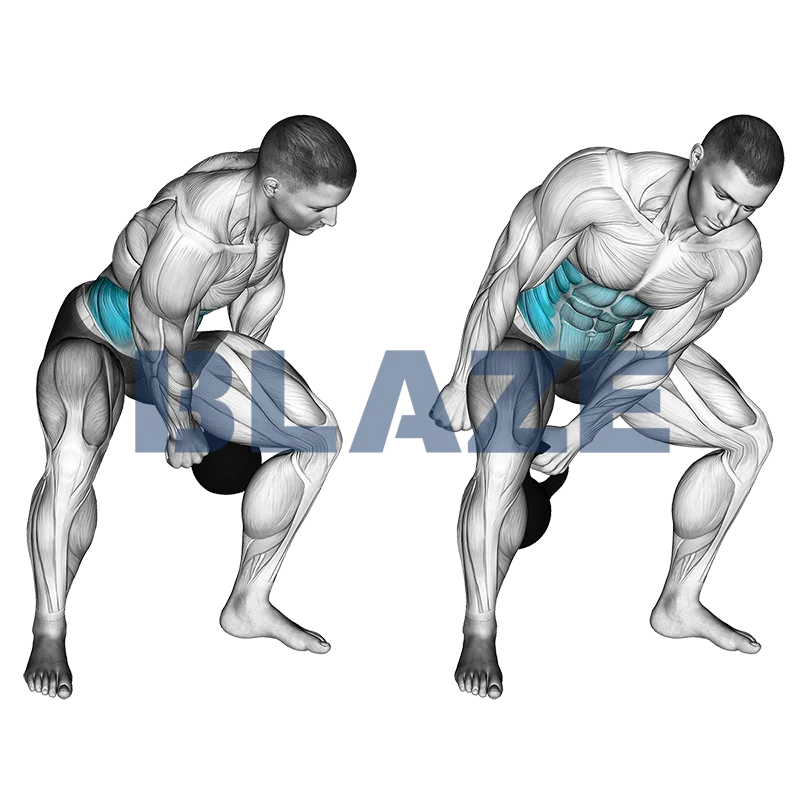
The kettlebell figure 8 is a dynamic exercise that offers numerous benefits, including enhanced core stability, improved grip strength, and increased coordination. This exercise predominantly targets the core, obliques, shoulders, lower back, and forearms. An athlete can profit significantly from incorporating the Kettlebell Figure 8 into their routine as it promotes functional strength, enhances athletic performance, and aids in injury prevention by stabilizing the core and improving muscular balance and coordination. This makes it a valuable addition to any training regimen.
Community Averages
12kg
Avg. weight
26lbs
Avg. weight
* Based on data from the Blaze community
Description
- 1Stance and Position: Stand with a wider-than-shoulder-width stance and place a kettlebell between your legs.
- 2Bend Over: Push your butt out and maintain a flat back as you bend over to reach the kettlebell.
- 3Pick Up the Kettlebell: Grasp the kettlebell with one hand.
- 4Pass the Kettlebell: Pass the kettlebell to your other hand by reaching from behind your legs.
- 5Continue Passing: Keep passing the kettlebell back and forth between your hands for several repetitions.
- 6Maintain Form: Throughout the exercise, keep your back flat and core engaged.
Tips & Tricks
- •Maintain a Strong Posture: Ensure your back is straight and your core is engaged throughout the movement. This helps in maintaining balance and prevents injury.
- •Controlled Movements: Focus on smooth and controlled movements rather than swinging the kettlebell aggressively. Control is key for preventing strain and maximizing effectiveness.
- •Proper Grip: Use a firm but relaxed grip on the kettlebell handle. This helps in maintaining control without straining your hands or wrists.
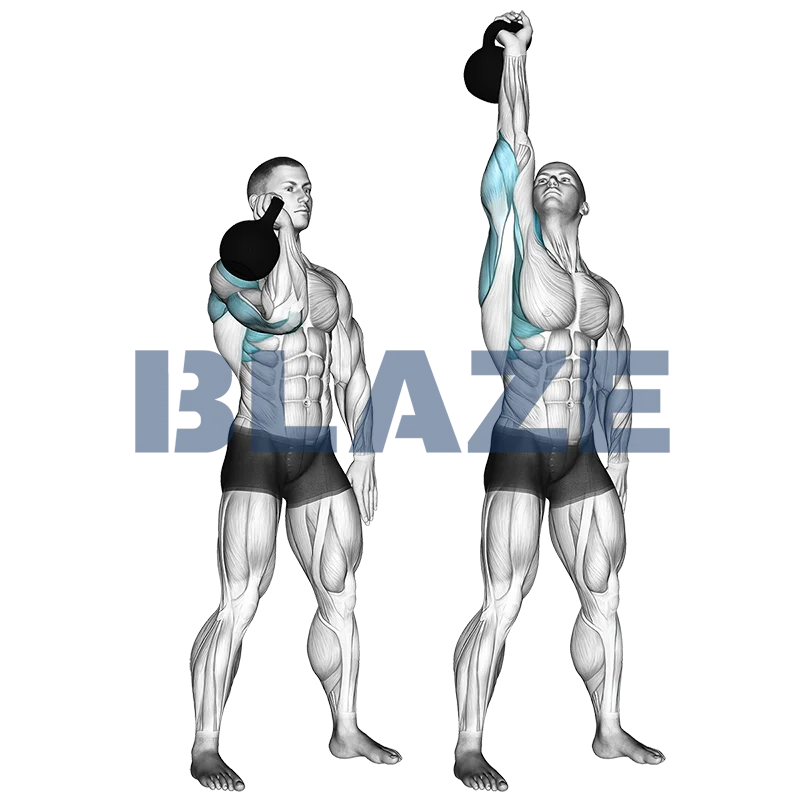
The kettlebell seated one arm military press is an excellent upper body exercise that targets multiple muscle groups, including the shoulders, triceps, and core. By performing this movement, athletes can enhance shoulder stability, increase strength, and improve unilateral balance. This exercise is particularly beneficial for athletes who need strong, stable shoulders for their sport. The core engagement required to maintain posture during the press also helps in building overall stability. Adding it to a workout regimen can contribute to improved athletic performance and injury prevention.
Community Averages
12kg
Avg. weight
26lbs
Avg. weight
* Based on data from the Blaze community
Description
- 1Starting Position: Stand with feet shoulder-width apart and a kettlebell on the floor between your feet. Bend your knees and hips to grasp the kettlebell with one hand, keeping your back straight.
- 2Clean the Kettlebell: Extend through your legs and hips to pull the kettlebell off the floor. Rotate your wrist as you lift the kettlebell toward your shoulder, making sure your palm faces inward.
- 3Stabilize: Once the kettlebell is at your shoulder, stabilize your body by contracting your lats, butt, and stomach muscles.
- 4Press Up: Look at the kettlebell and press it up and out until your arm is fully extended and locked out overhead.
- 5Lower the Kettlebell: Carefully lower the kettlebell back to your shoulder in a controlled manner.
- 6Repeat: Ensure your body remains stable, and repeat the motion for the desired number of reps.
Tips & Tricks
- •Engage Your Core: Maintain a tight core throughout the entire press to stabilize your spine and prevent any arching. This will also help in maximizing power during the lift.
- •Elbow Position: Keep your elbow tucked close to your body at the start of the press. Avoid flaring out the elbow to reduce strain on your shoulder joint.
- •Neutral Wrist: Keep your wrist in a neutral position to maintain a firm grip on the kettlebell and to reduce the risk of wrist strain. Avoid bending the wrist backward or forward.
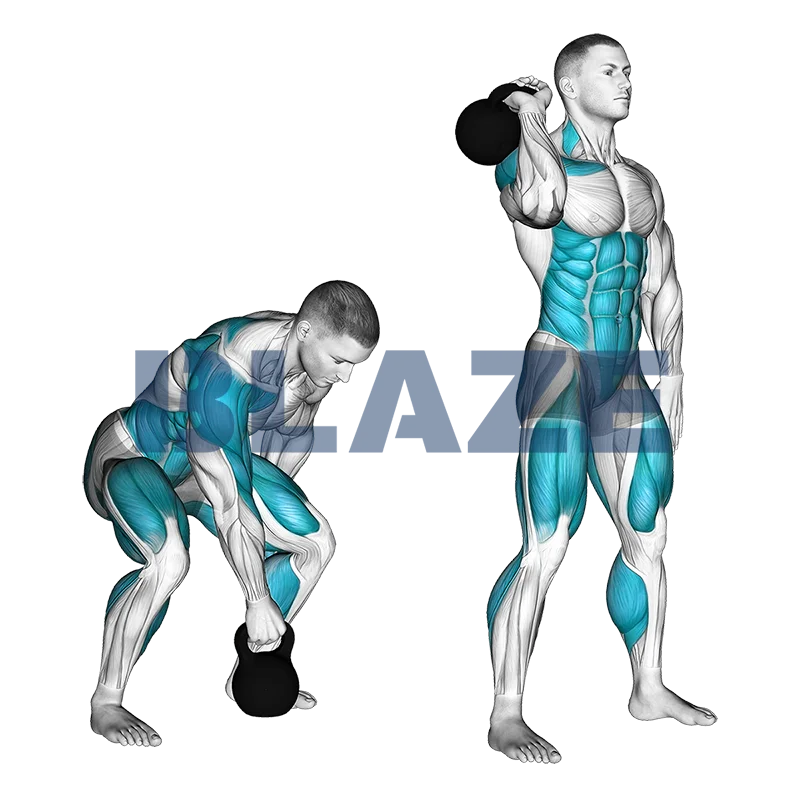
The kettlebell one arm clean is a dynamic exercise that offers multiple benefits, particularly for athletes. Primarily, it targets the upper and lower back, shoulders, arms, and core, enhancing overall strength and stability. Additionally, it promotes explosive power and coordination, essential for athletic performance. This exercise also aids in improving grip strength and unilateral balance, helping to correct muscle imbalances. Athletes may profit from incorporating the Kettlebell One Arm Clean into their routine for improved functional strength, agility, and injury prevention.
Community Averages
12kg
Avg. weight
27lbs
Avg. weight
* Based on data from the Blaze community
Description
- 1Setup: Place a kettlebell on the ground between your feet. Stand with your feet shoulder-width apart.
- 2Initial Position: Bend at the hips and knees to squat down. Keep your back straight, push your butt back, and look forward as you reach down to grab the kettlebell handle with one hand.
- 3Lifting to Shoulders: Drive through your heels to extend your legs and hips, lifting the kettlebell upwards. As the kettlebell rises, rotate your wrist to bring it to your shoulder level.
- 4Final Position: Ensure the kettlebell rests on the back of your wrist and your elbow remains close to your body.
- 5Lowering the Kettlebell: Carefully return the kettlebell to the starting position by reversing the motion—lower it back down between your feet with a controlled movement.
- 6Repeat: Complete the desired number of repetitions, alternating arms if needed.
Tips & Tricks
- •Start with Proper Weight: Choose a kettlebell that you can handle with good form. Starting too heavy can lead to poor technique and potential injury.
- •Focus on Form: Ensure your back remains straight and your core is engaged throughout the movement. Proper form is more important than the amount of weight you lift.
- •Use Your Hips: The power for the clean comes primarily from your hips. Use a strong hip hinge to generate the necessary force for lifting the kettlebell.
Start this workout in the Blaze app
Download Blaze Workout Tracker and follow this plan with guided sets and tracking.